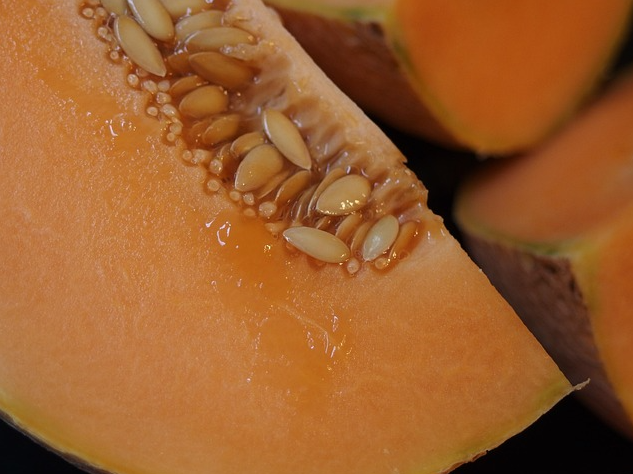
One of the summer fruits I love most is melon, a fruit that demonstrates delicate and non-overwhelming sweetness, together with a crisp and melting texture. What is called – perfect. This is an old friend in the neighborhood.
A plant from the Cucurbitaceae family whose wild varieties are common in the space between the Indian subcontinent and North Africa. Archaeology provides us with abundant evidence that melon has been an agricultural crop for at least six thousand years. In the Land of Israel, melon seeds have been found at sites dated from the Early Bronze Age (about 3000 BCE), through the Roman period (first century CE) and onwards.
That is, melon cultivation is a practice that has never ceased in the Land of Israel. On the other hand, even though we have been growing melons continuously for almost 5,000 years, this does not mean there have not been significant changes along the way.
As a common and veteran fruit that has been grown and cultivated in all corners of the globe for hundreds of years, melon has a long evolution and amazing varietal diversity. Amazing varietal diversity?
For most Israelis over the age of 30, melon is a fairly generic fruit, and when we were children, all melons looked the same – spherical appearance, rough yellowish skin and whitish-greenish flesh – so what 'varietal diversity' am I talking about?
Well, those who grew up here in the seventies and eighties knew mainly one variety of melons – the Galia variety. Let us take a moment of Israeli pride. In the early seventies, a team of researchers from the Volcani Institute, led by Dr. Zvi Karchi, made several crosses between several melon varieties. In 1973, a new melon was released to the market – Galia melon, named after Dr. Karchi's daughter, was a wonderful melon.
Wonderful? Sorry, perfect. Galia was such a successful fruit that it pushed most previous varieties out of the market. This is a phenomenon I call 'varietal imperialism'. Sometimes a variety emerges that enjoys an advantage in taste, is easy to grow, and has a long shelf life – everyone is satisfied with it, the market demands it.
The result: by the mid-seventies, the vast majority of melon growers in Israel switched to Galia. Do not misunderstand me – Galia is an excellent melon. I am really in favor of it, but 'varietal imperialism' is a problem.
Diversity is good, it is healthy, it is interesting and, it opens new possibilities and allows us to be more culinarily precise and allows us to preserve previous culinary heritage. So Galia melon is great; the good news is that it is no longer alone.
In the last decade, several varieties of melons can be found in Israel. In melons, varietal diversity is not trivial and is expressed in taste, smell, color, size and texture. We too, in the garden, love diversity and are always happy to counter 'varietal imperialism', so this week we offer you two lesser-known melon varieties: the Ponto melon and the Spanish melon.
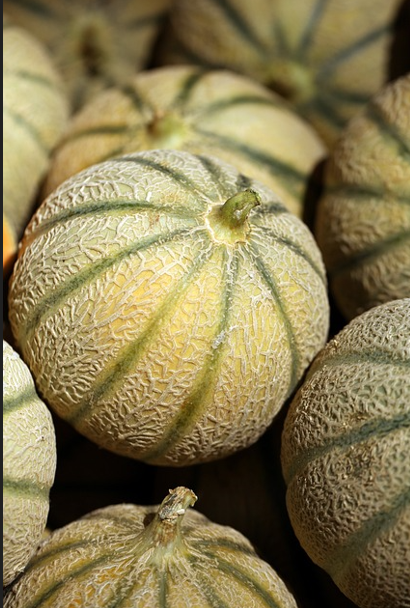
Ponto melon is a melon developed in Brazil. In its appearance, it somewhat resembles a watermelon; it has an almost round shape, smooth skin in a light color with green touches. Its flesh is white and sweet, and its texture is crispy.
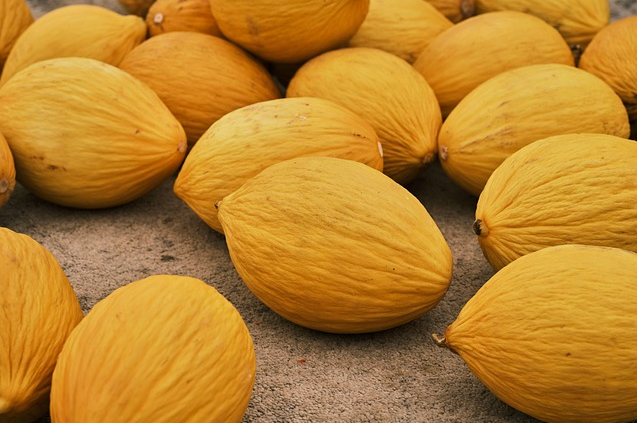
The Spanish melon is yellow on the outside, has an oval shape and has orange and juicy flesh. So in short, vary your melons! And one more thing, whether it is Galia, Ponto or Spanish melon – make sure to chill the melon before serving – this really makes any melon much more delicious.