Every child knows that the fig is mentioned in the Bible (for example, in the famous verse from Micah: "under his vine and his fig tree") and that it is counted among the 'seven species of the land'.
Really? Well, things get a bit complicated. There is no dispute that the fig, as a cultivated plant and agricultural crop, has been part of the Levantine landscape for at least 6,500 years. I write 'at least' because a few years ago, remains of sterile figs were found at an archaeological site near Kibbutz Gilgal. These figs were dated to the Neolithic period, 11,500 years ago.
That is, when the prophets and scribes who wrote the biblical text were active, figs were already an integral part of the local landscape. On the other hand, wild varieties of fig did not develop in Israel, because the fig is actually a variety of ficus.
The origin of ficus trees is in the more tropical regions of Asia and Africa. Like most ficus trees, the fig probably also developed in present-day India and at some point reached us as a cultivated plant. As a rule, ficus trees do not reproduce outside their natural growing regions, and therefore (at least until 40 years ago) every ficus you encountered, including the sycamore fig, which was also brought here as an agricultural crop already in biblical times, is a tree that someone planted.
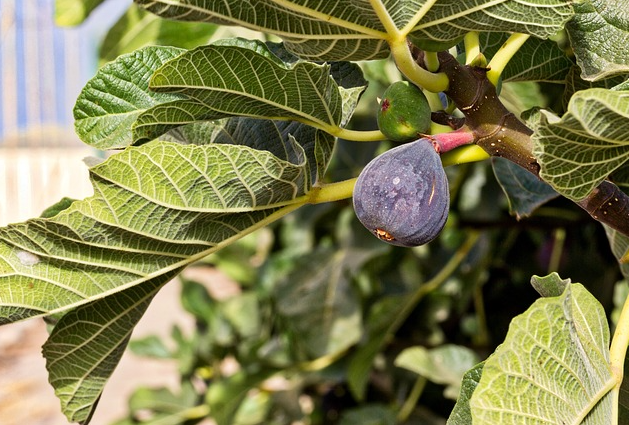
From this perspective, the fig is somewhat exceptional, because figs can indeed reproduce in Israel spontaneously. This is less trivial than it seems to you, and it is time to make acquaintance with the secret partner of the ficus – the fig wasp.
The story of the wasps and the ficus trees is a fascinating example of a rather rare phenomenon called 'coevolution'. Simply put, the evolution of wasps and ficus trees went hand in hand, because without wasps we would not have ficus trees and vice versa.
There are hundreds of types of ficus in the world, with each type of ficus depending on a unique type of fig wasp that only it can pollinate (and only it allows the next generation of wasps to continue). Let us explain: the fig is not really a 'fruit'; it is actually a flower that grows inverted.
That is, the stamens and petals grow inverted in a formation called a syconium. The fig wasp develops inside the syconium of male plants; it cannot penetrate female syconia but performs pollination in them (in the attempt to penetrate).
The fig is exceptional in that its wasp immigrated here in ancient times, and therefore it can reproduce in Israel. Unlike, for example, the sycamore, whose wasp did not arrive here, and therefore every sycamore you encounter was planted at some point by a human.
Speaking of wasps and ficus trees, over a year ago the British brought here from India a ficus tree that earned the name boulevard ficus. It grew quickly, developed a wonderful landscape, and not by chance the whole country is full of them. It was brought here precisely because its wasp was not in the environment, which also made it a tree that did not produce fruit.

And then, sometime during the seventies, the ficus wasp infiltrated here (probably as a stowaway in a tree shipment that arrived from the East) and suddenly the formerly clean tree develops dirty fruits and also grows spontaneously everywhere.
By the way, the fact that the fig is a cultivated plant for many years led to the creation of parthenocarpic varieties, meaning varieties that reproduce and develop fruits (syconia in the case of figs) even without pollination by a wasp, and most figs grown in Israel belong to this group.
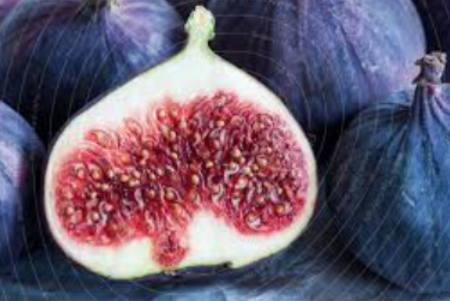
In any case, now at the height of summer, the figs are also at their peak. I let them cool for an hour in the refrigerator and then, simply wow…