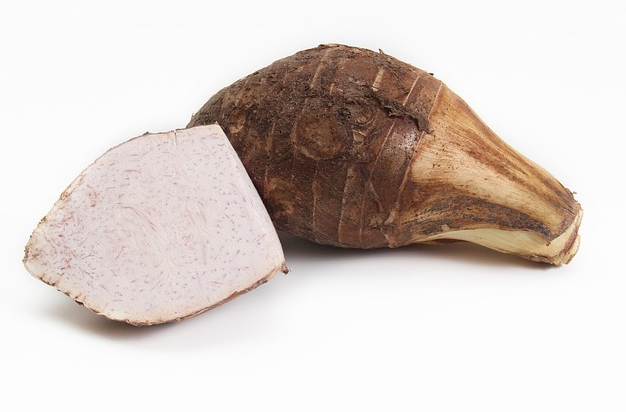
This week, a root vegetable you have probably never heard of is visiting the garden: taro. It is a plant from the arum family, whose thickened root is rich in easily digestible starch which makes it reminiscent of the potato. In some parts of the world, its leaves are also eaten; after blanching or cooking, they resemble spinach in both flavor and texture.
It is important to note that taro must never be eaten raw. In its uncooked state, it contains calcium oxalate, a toxic compound. Oxalate breaks down quickly during cooking, so in this respect taro is not unusual after all, no one thinks of eating potatoes raw either.
Taro originated in India and Southeast Asia, and in fact refers to a whole family of many different varieties. So far, nothing here should be surprising: taro is not the first Asian vegetable unfamiliar to the Israeli palate to make an appearance in this column. But this case is different because Taro is actually not new to our region at all.
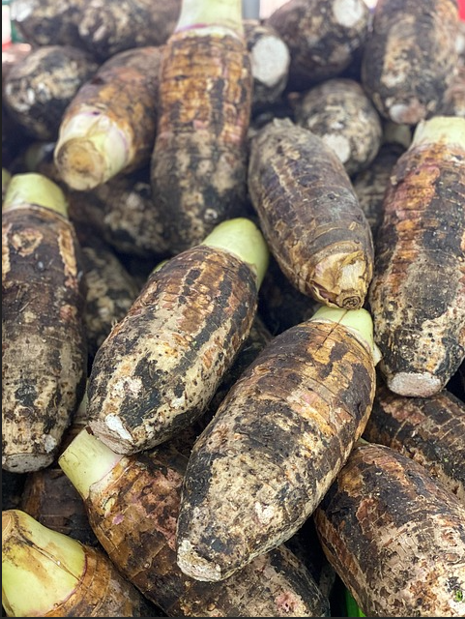
Taro is one of the very first vegetables ever domesticated by humans, most likely in the Indus Valley more than 10,000 years ago. And it was not a crop that stayed confined to Asia. Estimates suggest that by the second millennium BCE, taro was already a common crop in the Middle East and southern Europe.
In fact, it is mentioned multiple times in the Mishnah (to be precise, likely not the exact same variety, but a close relative), and it even has an ancient Hebrew name: kolkas. I say “Hebrew,” but in truth, the sages adopted the Greek name and rendered it in Hebrew transcription.
Kolkas was an important crop in this land and even appears in the Beit She’an mosaic from the Byzantine period. It continued to be cultivated throughout the Arab and Ottoman eras and was still familiar in the markets of the Land of Israel in the early twentieth century.
Interestingly, kolkas (taro) also became a major crop in Africa and across the Pacific Islands. This alone is a remarkable story: the first Polynesian settlers carried taro tubers with them and acclimatized them on every island they reached. When Polynesians began settling the island chain we now know as Hawaii in the third century CE, they brought taro with them in their canoes. Today, there are hundreds of taro varieties in Hawaii, and it is considered the island’s national food.
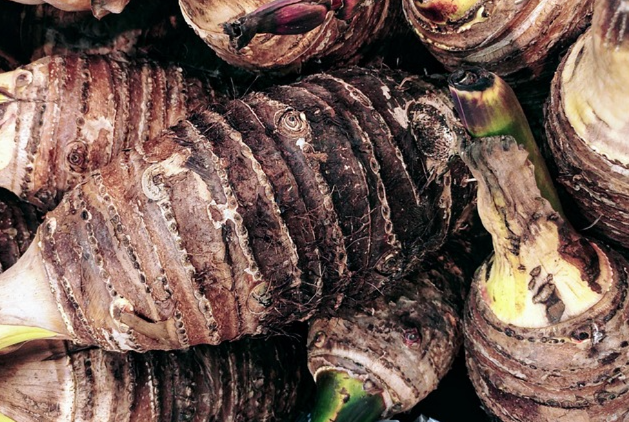
So why did taro or kolkas disappear from our neighborhood? I do not have a definitive answer. Most likely, potatoes simply proved easier and more profitable to grow one of the downsides of a globalized economy. Theree other hand, there are places (like Hawaii, Southeast Asia, and Africa) where taro never disappeared. And since we live in a global world, here it is again, an old acquaintance you never knew you were missing, making a welcome return.
What do you do with it?
It is perfect for an exceptional mash, with a rich, slightly sticky texture. This weekend, I plan to add it to a steaming, wintery casserole.