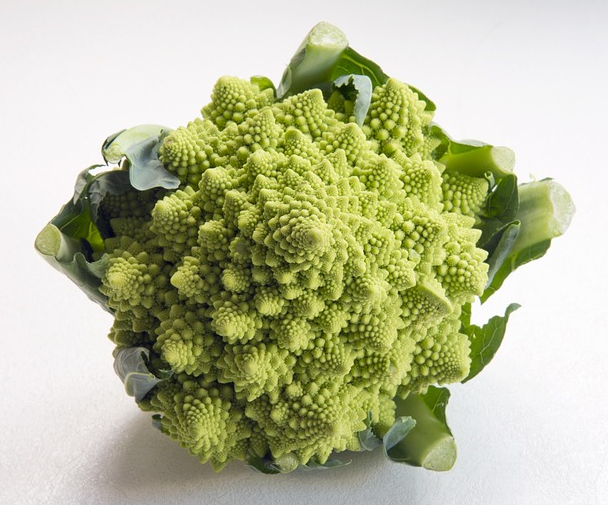
It has been a long time since Romanesco cauliflower last visited our corner of the world, and now it’s back, perfectly timed for winter, instantly putting me in a creamy, comfort-food mood. One of the more interesting things about Romanesco cauliflower is that most of the world knows it by a different name: Romanesco broccoli.
Translated literally, that’s “Roman broccoli.” The Italian connection is clear but why broccoli? Which raises the obvious question: is it a cauliflower, or is it a broccoli?
The clever and honest answer is this: on the one hand, Romanesco is neither cauliflower nor broccoli. On the other hand, you could argue it’s both.
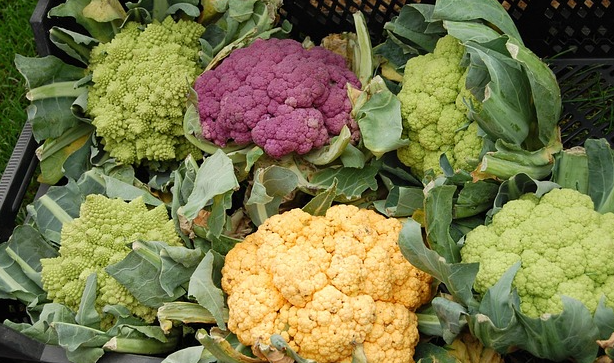
Confused? Fair enough. But if you have been following this column for a while, you may remember that botanically speaking, most of the familiar cruciferous vegetables of the Mediterranean basin – cabbage, broccoli, kohlrabi, Brussels sprouts, and cauliflower are all direct descendants of wild European cabbage. Direct descendants, yes but shaped by different paths of domestication that emphasized different traits.
Romanesco cauliflower is one such descendant. As with broccoli and cauliflower, the cultivated and eaten part of the plant is the inflorescence. That alone places all three remarkably close together—a tight little subfamily within the broader cabbage lineage.
And yet, while all three are technically flowers, they express different phenotypes in color, structure, and texture. Which brings us back to Romanesco or perhaps we should say Romanesco broccoli.
Personally, I prefer the beautiful Hebrew name, which nods to the vegetable’s striking, almost alien geometry. Although the variety was developed in southern Italy toward the end of the 16th century, its original ancestor was most likely a cauliflower rather than a broccoli.
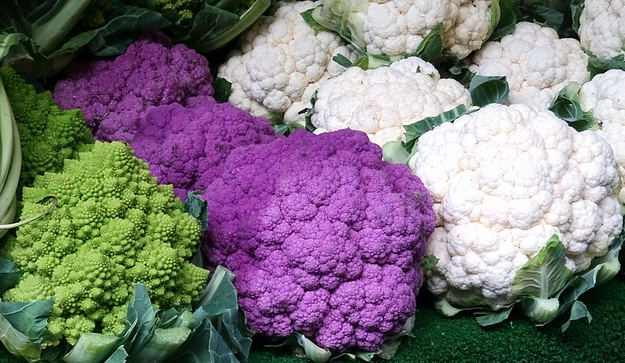
That said, in practical terms of color, flavor, and texture both interpretations hold water. This vegetable genuinely feels like a successful (and slightly odd) hybrid of the two. It starts with the color: classic cauliflower is creamy white, broccoli is green (yes, I know there are purple and orange versions of both), and Romanesco lands somewhere right in between.
That shade even has a name: chartreuse, a blend of yellow and green that is neither fully one nor the other. The texture of the florets is firmer and crunchier than broccoli, yet still more tender than cauliflower.
And the taste? To me, it is a harmonious mix of both simply delicious. So why don’t we see it more often? Because that’s life in a globalized, modern agricultural system: some varieties fall between the cracks. Sometimes it is due to historical trends that favored certain crops; sometimes it is because a vegetable is harder to grow or less profitable per kilo.
I do not know exactly why Romanesco cauliflower remains relatively obscure. On paper, it is a well-established cultivated vegetable around for nearly five hundred years and it was popular in parts of Italy long before tomatoes ever arrived there. But facts are facts.
What I do know is this: culinarily, it is a fantastic vegetable because it combines the best of broccoli and cauliflower. It is a perfect winter stew vegetable.
So yes, the season is short, and only a handful of local organic growers cultivate it, but it is here now. I don’t know about you, but I am definitely in the mood for a creamy Romanesco cauliflower stew.