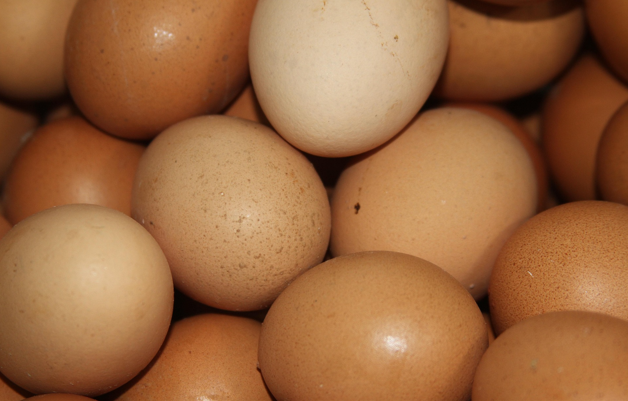
Here at the garden, we focus mainly on fruits and vegetables, but we also carry a selection of products that come from organic farming. That includes the organic free-range eggs from Borochov Farm, which I promise I will return to at the end of this post. But first, I am going to treat the egg, and the chicken that laid it, just like any fruit or vegetable featured in this weekly column. In other words, let us start with when and where it all began.
We will finally be giving a clear and definitive answer to the question that has troubled humanity forever: which came first, the chicken or the egg?
Life on Earth began when the planet was covered in water, and the first multicellular organisms evolved in the sea. That includes fish, which developed the egg as a kind of external reproductive system. True, a fish egg is very different from a chicken egg, but even if we compare the chicken to the earliest egg from which its prehistoric ancestor hatched, the egg will always come first. That is simply how evolution works.
Around 350 million years ago, give or take 15 million, aquatic animals began adapting to life on land. It was an incredibly slow process of natural selection, but eventually it gave rise to birds, most likely descendants of dinosaurs. They brought the brilliant idea of an external womb with them, although the eggs themselves evolved into the familiar structure we know today, with a shell surrounding the white and yolk.
At some point in Southeast Asia, a bird appeared that we would recognize as a chicken: poor at flying, equipped with a comb, unusually heavy for a bird, and making a very recognizable “cock-a-doodle-doo!” And yes, that chicken hatched from an egg.
Case closed.
When humans appeared around 150,000 years ago, they gathered eggs, hunted the birds that laid them, and ate both. About 5,000 years ago, a group of people living in the Indus Valley domesticated one of the pheasant-like species we now know as wild junglefowl.
Although we are talking about an animal rather than a plant, the principle of domestication is much the same. Humans preserved and bred individuals with desirable traits, such as more meat, more eggs, and a calmer temperament. The result was the domestic chicken, which quickly spread throughout the Old World. Our ancestors in biblical times were familiar with it as well.
One indication of just how long chickens have been part of life in our region can be found in the Hebrew word itself. Tarnegol, the Hebrew word for rooster, is one of the few words preserved from Akkadian, a language that disappeared more than three thousand years ago.

In any case, we humans eat eggs, and plenty of them. Over time, raising chickens for eggs became an industry, and that comes with problems. Put aside for a moment the health concerns associated with industrial agriculture in general. When it comes to poultry farming, there is another issue that does not usually arise when I write about fruits and vegetables: animal welfare.
I would not wish the life of a battery hen on any living creature. Extreme overcrowding can lead to injuries and mutilation, while exposure to hormones and antibiotics takes its toll on the body. In short, these chickens often live short and miserable lives.
Fortunately, there is another way.
The eggs we carry from Borochov Farm come from free-range chickens that go out to pasture every day and are fed a rich, organic diet that is also supplemented with Omega-3. The result is eggs that are not only tastier, but healthier too.
Yes, organic free-range eggs cost more than conventional eggs.
For me, that is a price worth paying, both for what is on the plate and for a clear conscience.