We are at the peak of August, and for the second week in a row, I am introducing you to a cactus fruit. Honestly, once you step out of the air conditioning, it even feels poetic, what plant could represent the Israeli August better than a cactus?
On the other hand, all cacti originate in the “New World” including our very own sabra (which, not coincidentally, is also at its peak right now, and you will find it in your box this week too). Still, this pairing feels like a perfect match.
Last week, I introduced you to the dragon fruit, the pitaya. This week, meet its close cousin, some even call it a subspecies of pitaya – the kubo.
So, what exactly is “kubo”? And why, paradoxically, could it also be called the most “Israeli” cactus of all, even though it only arrived in Israel in 1985?
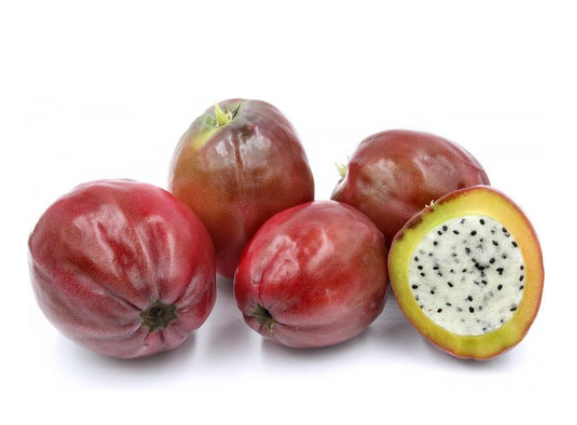
Well, the kubo’s story is tied to an attempt by Professor Yosef Mizrahi to develop pitaya cultivation in Israel. Mizrahi traveled through Central and South America, collecting seeds and cuttings of fruit-bearing cacti from the pitaya family. One of those plants was a cactus called Cereus, which grows in a column shape and produces a round red fruit with sweet, soft flesh.
This fruit, sometimes known as the “Peruvian apple” had been eaten by indigenous peoples for centuries but was never developed for commercial cultivation. In 1985, however, a test plot of Cereus was planted in Israel.
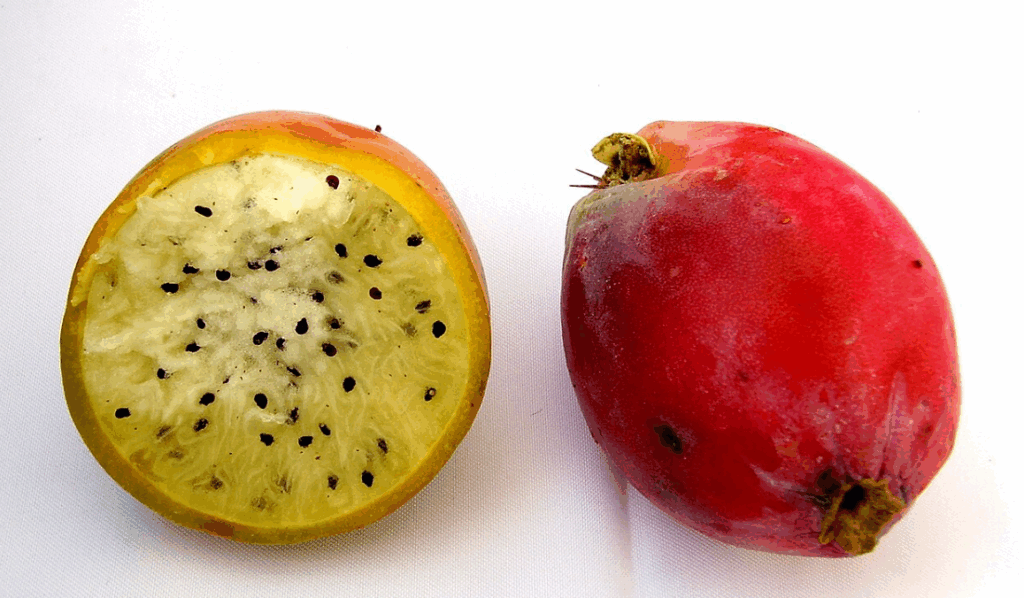
The Cereus has beautiful pink flowers, but there was a problem, Israel has no natural pollinators for it. Without pollination, the flowers do not turn into fruit. So in Israel, the flowers had to be hand-pollinated (which complicates and raises the cost of cultivation). Even so, the results were lovely: fruits with a delicate sweetness and a flavor reminiscent of pineapple and banana. Bonus: they also have an incredibly low glycemic index, making them especially suitable for people with diabetes.
The experiment’s success led to several plots of Cereus being planted in Israel, making it the only country in the world where this fruit is grown commercially. And yes, the name “kubo” is a completely Israeli invention.
Why kubo? I have no idea. Maybe someone thought it looked like kubeh. For a few years, all the kubo grown here was exported, but the industry proved less profitable, and today, kubo is grown on a few plots and marketed only in Israel.
Personally, I love chilling it in the fridge, cutting it in half, and eating it with a spoon. Beyond that, August feels like too much work, but I can imagine it as the basis for a refreshing sorbet or a beautiful addition to any fruit salad.