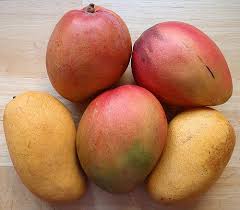
It is probably no coincidence that since August arrived, this column has been filling up with tropical fruits. The heat and humidity of August are exactly what many tropical fruits need to reach their peak. If you like, you can think of it as a small consolation for this dreadful month. After all, what else is there to do besides finding a little breeze (or locking yourself in the air conditioning) and enjoying a sweet tropical fruit, like the Maya mango we met last week, or this week’s star, the passion fruit.
The first time I encountered passion fruit, I was still a young girl growing up in a small town sometime in the late 1980s. Gadi, the neighbors’ son, showed me a climbing vine growing in their yard. It had strange, round purple fruits, some of which had already fallen to the ground.
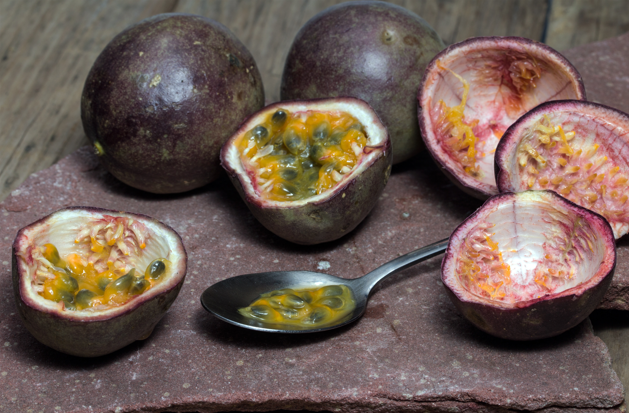
Gadi picked one up and called it shaonit, which is actually the official Hebrew name for passion fruit, shaonit ne’echelet. He took out a pocketknife, cut the strange fruit in half, and revealed a mass of yellow pulp and seeds inside. He offered me one half. I was suspicious and refused. Only after he took his half and happily slurped down the pulp did I agree to try this strange fruit myself. It did not take long before we had gathered all the ripe ones and finished every last one.
The fruit we all call passion fruit today is a tropical plant native to South America, where around 400 wild varieties are known. Following the discovery of the Americas, it spread to tropical growing regions around the world and became a common crop in Southeast Asia, Africa, and Australia.
It arrived in the Land of Israel at the beginning of the 20th century, but only in recent decades has it become a commercial crop that regularly appears in our markets. So let us talk a little about passion fruit. I may have first known it by its Hebrew name, shaonit, but we will stick with the Latin-derived name with its Christian origins, given to the plant by Spanish priests who arrived in South America in the 16th century.
As mentioned, passion fruit grows on an evergreen climbing vine with tendrils, those little arms that allow climbing plants to grip walls, fences, and trees. There are two main edible varieties growing around the world. Here in Israel, we are familiar with the small purple variety that reached us from Australia, but there is also a yellow-skinned variety that can grow to about the size of a grapefruit.
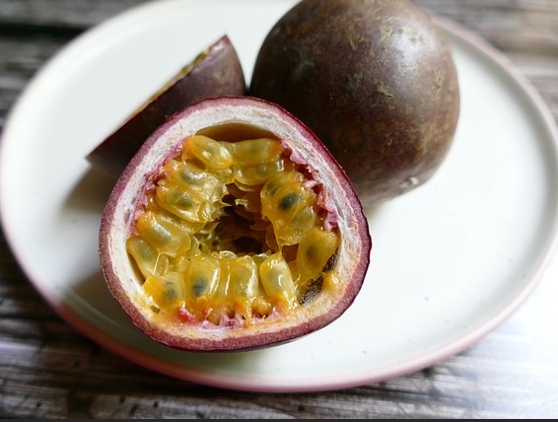
Inside the fruit, and this is something all varieties share, are yellow seeds with dark centers, surrounded by plenty of sweet and sour juice with a completely distinctive flavor.
What does that mean? Well, it tastes like passion fruit.
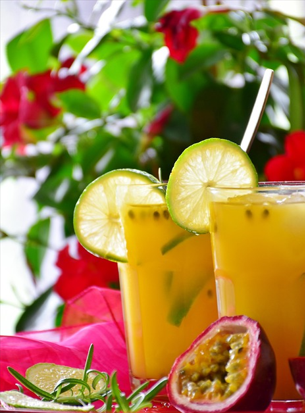
And right now, in the middle of August, the taste of a cold passion fruit straight from the refrigerator is exactly what I need. You can make a wonderful sorbet with it. You can add it to a fruit smoothie. But what I really want is to cut a fresh passion fruit in half, take one half, bring it to my mouth, slurp it down, close my eyes, and surrender to the flavor.