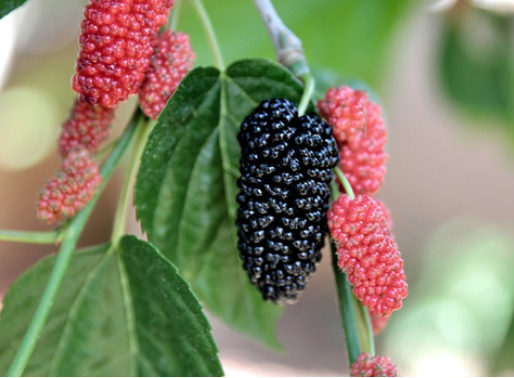
The mulberry tree is one of my favorite fruit trees. Not just because of its wonderful fruit which truly belongs to a category of its own but also because it is an impressive tree that can live for decades. And there is something else that sets the mulberry apart from most cultivated fruits and vegetables: its story of domestication is tied to something entirely different.
Mulberries were domesticated at least 6,000 years ago in China. What makes their story unique is that they were not domesticated for their fruit, but for something else altogether.
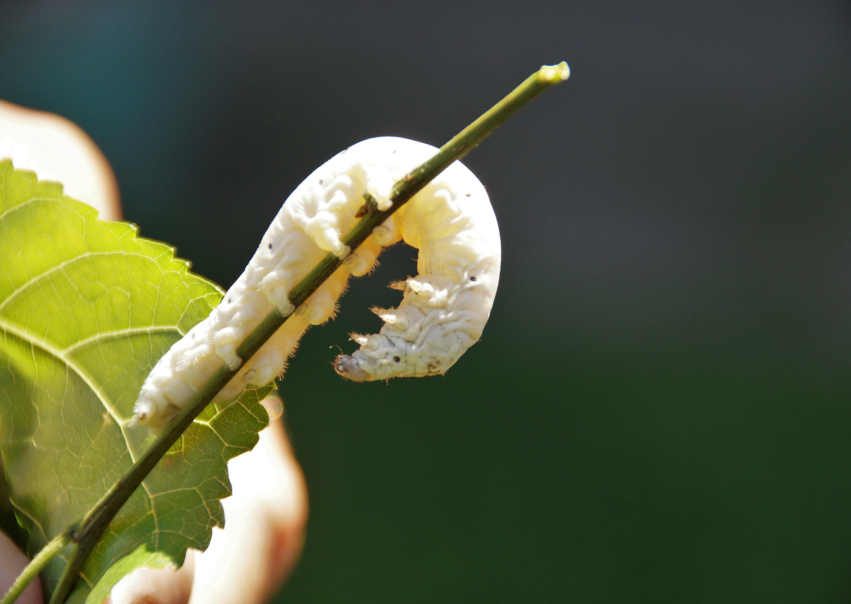
It turns out there is a moth, the silkworm whose larvae feed exclusively on mulberry leaves.
Why does that matter? Because when the larva transforms into a cocoon, it spins it from a fine yet incredibly strong protein fiber. The Chinese discovered that this fiber could be woven into exquisite fabrics and that is how the silk industry was born.
There is an ancient Chinese legend, dating back to the 3rd millennium BCE, which illustrates just how important this crop was and still is in Chinese culture. According to the story, Empress Leizu was sitting beneath the lush canopy of a grand mulberry tree, sipping hot tea from a porcelain cup. As she enjoyed the peaceful moment, something happened that echoes the famous story of Isaac Newton (who, more than 4,600 years later, also sat beneath a tree, though his was an apple tree).
A silkworm cocoon fell straight into her steaming tea. The hot water loosened the fibers, revealing delicate silk threads and with that, one of the greatest revolutions in textile history began.
So yes, as strange as it may sound, the mulberry tree was cultivated throughout much of history not for its fruit, but because its leaves feed silkworms. This was true in China and broadly true for the global spread of mulberry cultivation.
The mulberry reached the Land of Israel in the 6th century CE, toward the end of the Byzantine period, most likely as part of an attempt to establish a local silk industry. That effort met with only partial success.
In the 12th century, Arab communities introduced the white mulberry, and a silk industry developed here for several decades before eventually fading away. But the trees and their fruit remained long after the silk workshops closed.
Like any fruit tree, mulberries come in many varieties. Today, around seventeen primary types are known. Most originate from Asia, particularly China and the Himalayan region, though surprisingly, there are also mulberry varieties native to the New World.
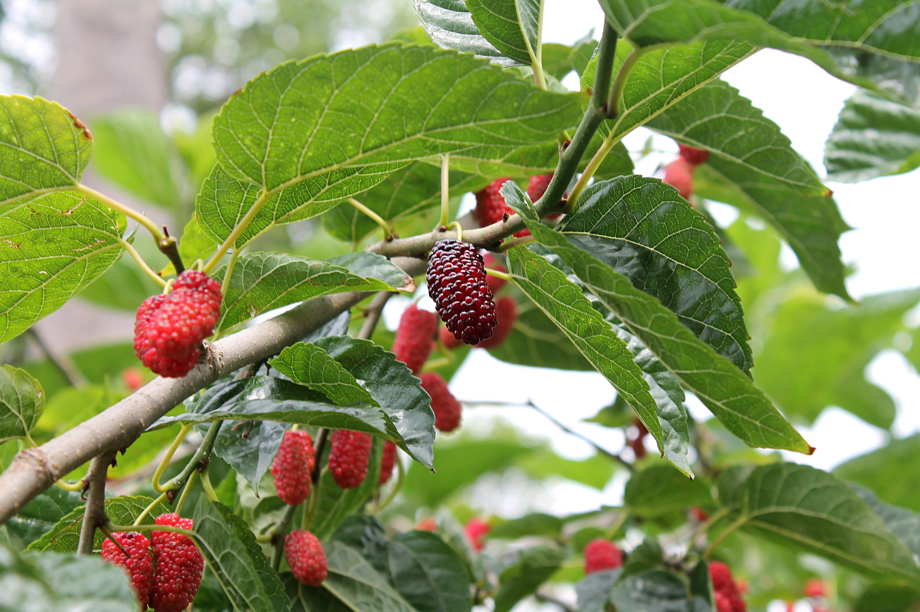
Unlike the berry we call “strawberry,” mulberries have always been somewhat challenging from a commercial perspective. At least in my generation, most mulberry experiences come from picking them straight off a tree in a backyard or neighborhood street. Today you can occasionally find them in markets but still only in limited quantities.
Mulberry varieties differ in color, sweetness, acidity, and shape. Their color can range from white to deep black, and sometimes even vary within the same variety.
The Afghan variety also known as the Pakistani mulberry originates from the slopes of the Himalayas and has a distinctive trait: its fruit is unusually long, sometimes up to three times the length of other varieties. It is also exceptionally sweet and not something you come across every day.