There is an ongoing debate about the true birthplace of okra. Some argue it originated on the Indian subcontinent, while others point to East Africa, since wild relatives of this member of the mallow family can still be found in both India and the Horn of Africa.
On one hand, the wild Indian varieties are genetically closer to modern cultivated okra. On the other, the remarkable diversity of wild African varieties, combined with archaeological evidence, suggests that the first domestication of the plant likely took place in Ethiopia. By ancient times, okra was already being cultivated in Ethiopia, Sudan, and Egypt. In fact, the earliest written record of okra as a food comes from Egypt.
What we do know for certain is that by the Middle Ages, okra had become a popular crop across much of the subtropical Old World, from Africa to India, including the Levant.
Speaking of its spread, written records show that by 1658, okra was already being cultivated extensively in Brazil, and by the end of the 18th century it had reached North America as well. Hidden within that journey is a darker story.
Okra almost certainly arrived in Brazil directly from Africa aboard the very ships that, between the early 16th and mid-19th centuries, transported millions of kidnapped Africans into slavery in the New World.
One widely accepted theory suggests that some of those captives carried okra pods with them. The seeds they contained found ideal growing conditions in Brazil’s tropical climate and flourished. To this day, okra remains strongly associated in Brazil with the culinary traditions of Afro-Brazilian communities.
Fortunately, none of that is the okra’s fault. In the end, it became a beloved crop because it is a true nutritional powerhouse. Compared with most vegetables, it contains a relatively high amount of protein, along with abundant dietary fiber, essential minerals such as iron, magnesium, and zinc, plus folate and a generous assortment of vitamins.
It is true that okra isn’t everyone’s favorite vegetable. In Israel, it is still most strongly associated with Arab cuisine and the North African and Levantine traditions of Mizrahi Jewish cooking. But honestly, that’s our loss.
Yes, I am well aware of the famous "slime" debate. In many cuisines, that natural mucilage is actually prized because it thickens soups and stews. Personally, I quite enjoy the texture. But for those who do not, there are simple ways to reduce it. Use plenty of lemon juice and, most importantly, keep the pods whole while cooking.
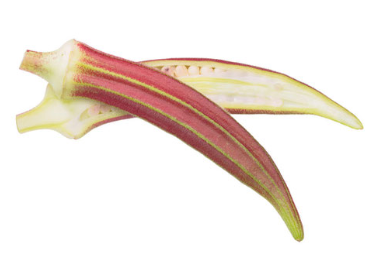
That was a brief introduction to okra itself. This week, however, we have something a little more special, an upgraded version, if you will. I am talking about the purple-red variety, a rare cultivar that does not appear very often and one that has just arrived in the garden.
Several pigments are responsible for the red and purple colors found in fruits and vegetables. In this variety, the key pigment is anthocyanin. Why does that matter? Because anthocyanins do much more than create a beautiful color. They are powerful antioxidants that give purple-red okra an added nutritional advantage over ordinary green okra.
One interesting detail is that once cooked, purple-red okra looks almost identical to green okra. Does that mean cooking destroys the anthocyanins and defeats the purpose?
Partially, yes. That is why, whenever I get my hands on purple okra, I usually skip frying or roasting. Instead, I simply boil it briefly or, even better, steam it. These gentler cooking methods preserve far more of the anthocyanins and allow this remarkable variety to shine.