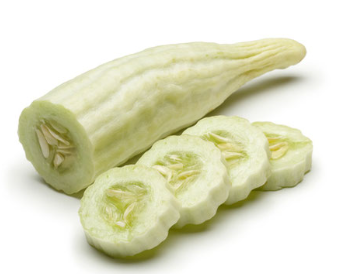
When I saw the beautiful fresh organic faqqus that arrived at the garden this week, I immediately knew they deserved their own column. In fact, I decided: to write an entire piece about faqqus without using the word cucumber.
As you’ve probably noticed, I failed rather spectacularly. And honestly, for good reason. Because in many ways, faqqus is actually more cucumber than a cucumber.
What do I mean by that? Well, when the word “cucumber” appears in ancient sources, it often describes a vegetable that is far closer to the faqqus sitting in your box today than to the modern cucumber we know.
In fact, the earliest cucumber-like vegetable that can be identified with reasonable certainty appeared in Rome during the first century CE. Its claim to fame was that it could be cultivated year-round rather than seasonally. This pale, slightly fuzzy, exceptionally sweet variety was particularly beloved by Emperor Tiberius (yes, the same Tiberius after whom the city of Tiberias is named).
Faqqus, also known as the Armenian cucumber or Egyptian cucumber, is indeed a close relative of the modern cucumber. Both belong to the gourd family of the Old World.
That said, emphasizing its relationship to cucumbers does faqqus a slight injustice, because it overlooks another important relative: the zucchini.
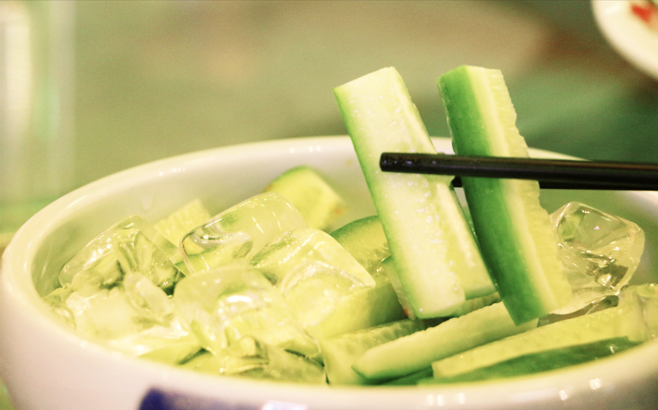
One of the wonderful things about faqqus is that it can do everything a cucumber can do. It’s fantastic in a fresh Arab salad, works beautifully in Greek tzatziki, and serves as a refreshing snack on its own.
But unlike a regular cucumber, faqqus can also behave like a zucchini. There’s no need to peel it, and it can be cooked. Once cooked, it begins to reveal a completely different personality.
Have you ever tried cooking a cucumber? Trigger warning: don’t. It generally ends badly.
Faqqus, on the other hand, thrives in the heat from barbecue grills to savory pies and quiches.
In some parts of Asia, faqqus is allowed to grow to lengths of up to 60 centimeters (24 inches), at which point its squash-like nature becomes obvious. Here, we usually harvest it while it’s still young and tender (and there are likely varieties bred specifically for that purpose), but every faqqus carries that hidden zucchini potential within it.
On this point, I can even lean on a rather distinguished authority. Frederick Hasselquist, the 18th-century Swedish naturalist and one of the pioneers of scientific exploration, traveled extensively around the Mediterranean and even visited the Land of Israel. He described faqqus as:
“The queen of cucumbers refreshing, sweet, firm, and wholesome.”
He also noted that in Egypt it formed a significant part of the diet of poorer communities, who served it as a cooked dish, a beverage, and a health food.
You see the point. In no universe not even among Egyptian farmers of the late 18th century could a regular cucumber substitute for meat in cooked dishes. Faqqus, surprisingly, does a respectable job of it.
I’m not dismissing the cucumber. There’s a reason it’s part of the holy trinity of salad ingredients alongside tomatoes and onions. Its great strength lies in its neutrality and soft texture.
Faqqus shares that refreshing neutrality, but adds a gentle sweetness and a satisfying crunch. Those two qualities make it far more versatile and in certain situations, considerably more delicious than the cucumber itself.