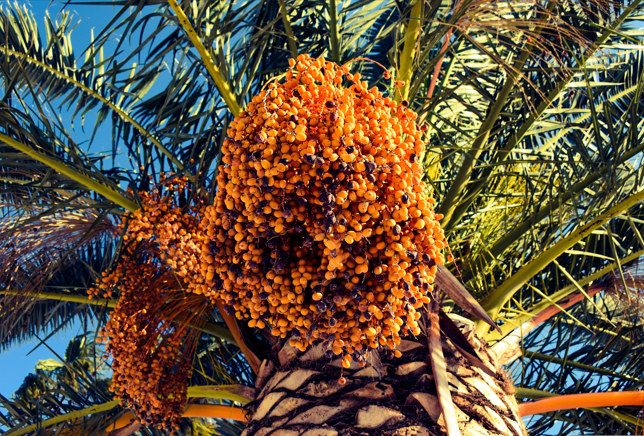
The Tishrei holidays are always a perfect reason to return to the date, one of our most iconic fruits, with several varieties reaching their peak right around now. Israel’s modern date industry certainly lives up to its glorious past. During the Hellenistic and Roman periods, dates from the Land of Israel were considered among the finest in the world. But then, sometime at the beginning of the second millennium CE, they disappeared from the local landscape for almost a thousand years.
The return of the date palm to the Land of Israel is one of the most heroic and successful agricultural stories of Zionism. I will not go into the full story this time, but it is worth mentioning that none of the date varieties grown commercially in Israel today are local varieties. They were smuggled into the country, mainly from Iraq, but also from North Africa.
Perhaps one day we will even meet the ancient Judean date again. Several specimens have already been successfully germinated from 2,000-year-old date pits discovered in archaeological excavations in Judea. Until then, we will happily settle for the wonderful dates growing in organic orchards in the Arava.
It is no secret that in recent years, the dominant date grown and eaten in Israel has been the Medjool. It is an excellent variety that adapted beautifully to local conditions. In fact, Israeli Medjools are now considered even better than those grown in Iraq. But even when it comes to dates, variety is a good thing.
So this time, I want to focus on a less common variety, the Deglet Noor, also known as the “royal date.” Less than 4% of the dates grown in Israel belong to this variety. Originally from North Africa and particularly common in Tunisia and Algeria, Deglet Noor is a medium-sized, elongated date with a distinctive honey-like flavor.
Although date cultivation disappeared from Israel for almost a thousand years, the tradition left us with a wonderful collection of Hebrew words and expressions that we still use today. Which brings us to gadid, the unique Hebrew word for harvesting dates.
There are several traditional and modern methods of harvesting dates, and the method varies depending on the variety. In the case of Deglet Noor, the harvest involves cutting the sansanim, the smaller branches that carry the fruit.
Yes, sansanim.
Here is another ancient Hebrew word that the revival of date cultivation allows us to roll around on our tongues with pleasure. Try it: san-sa-nim.
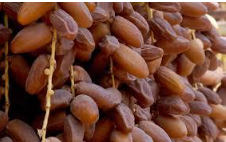
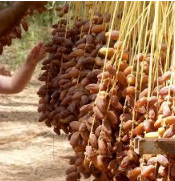
A sansan is the small branch that carries the dates, and in Hebrew, the word is used specifically in connection with the date palm. Deglet Noor dates are traditionally harvested together with these branches, and the fruit is later separated from them by shaking or beating.
But sometimes, when the Deglet Noor dates are particularly beautiful, they are left right on the branches. And today, we are in luck. The garden has received Deglet Noor date clusters loaded with beautiful fruit, giving us the perfect opportunity to enjoy this wonderful variety in a festive and unusual form.
They also happen to make a beautiful, natural centerpiece for the holiday table.
So for now, Chag Sameach, with dates still on the branch.